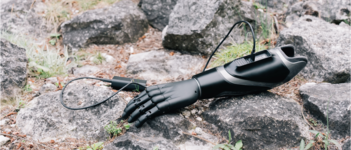







Aether Battery System: What Makes It Different?
The Aether Battery System from Aether Biomedical is made for robotic hands only, and it is installed inside the prosthetic socket. It powers the prosthesis and its components.
For clinicians, that design shapes the whole fitting. Clinicians set compatibility before planning the socket, place the components during fabrication, and explain the charging rules at handover.
Aether describes the system as an integrated power solution with real-time monitoring and USB-C charging. The figures below come from the Aether Battery System Instructions for Use (IFU), version 8, and Aether’s own product information.
What Is the Aether Battery System?
The Aether Battery System (AET-BAT-BS1) is a power system for upper-limb prostheses. Its battery pack is fixed to the inner surface of the socket, and its charging port is mounted into the socket wall.
Its main parts are:
|
Component |
Part code |
Role |
|
Battery pack |
AET-BAT |
Powers the prosthesis; fixed to the inner surface of the socket |
|
Battery charging port |
AET-CHR |
Mounted into the socket; has a USB-C connector, one button and four LEDs |
|
Connector board |
AET-CON |
Connects the battery pack and the charging port; provides a 2-pin kidney-style output to the terminal device |
|
Charging accessories |
AET-USBC, AET-PWR-USB-xx |
1 m USB cable (USB-A to USB-C) and an AC/DC power adapter for the country of use |
|
Charging port covers |
AET-COV |
Covers for the charging port |
|
Fabrication aids |
AET-DUM, AET-CUT, AET-DRL |
Help with the socket fabrication process |
Which Hands Can the Aether Battery System Power?
The Aether Battery System is intended for use exclusively with Zeus hands.
Use with non-Zeus multi-articulating hands is not supported and has not been validated by the manufacturer. The IFU also lists a contraindication: the system cannot be used with devices other than those specified by Aether Biomedical.
The battery and the bionic hand it powers are documented to work together by the same manufacturer. Before a fitting, check the full configuration against the Compatibility Guide (U03DC-0200) referenced in the IFU.
How Does the Socket-Mounted USB-C Charging Port Work?
The AET-CHR charging port is mounted into the prosthetic socket and secured with a biocompatible adhesive. According to the IFU, it has a USB-C connector and is used with the AC/DC power adapter provided.
Aether's charging guidance and the IFU give these details:
- Charging current: up to 1.2A.
- Charging time: up to 5 hours.
- Charger: the manufacturer-provided AET-PWR-USB-xx adapter and AET-USBC cable. A portable power bank is for exceptional situations only, and must not be connected to an electrical outlet while charging.
- When to charge: while the prosthesis and socket are disconnected from the patient. The system does not supply power to the prosthesis while it charges.
What Do the Charging Port LEDs Show?
The four LEDs on the charging port show the battery's charge level, whether the system is on, and whether charging is in progress or finished. Pressing the port's button turns the LEDs on.
|
LED behavior |
What it means |
|
LEDs light after pressing the button |
The current charge level, in four ranges: below 25%, 25 to 50%, 51 to 75% and 76 to 100% |
|
LEDs glow constantly for 3 seconds |
The system is turned on |
|
LEDs blink 3 times |
The system is turned off |
|
Last LED blinks quickly 6 times after a button press with the system off, or blinks constantly with the system on |
The charge level is critically low |
|
Blue LEDs light |
Charging is in progress |
|
All LEDs blink twice, then turn off |
Charging is finished |
What Does the Connector Board Do?
The AET-CON connector board connects the battery pack and the charging port, and it provides a 2-pin kidney-style output connector to the terminal device.
Two IFU rules apply when connecting it. The connectors only attach one way, so they should never be forced, and every wire should be connected to the correct connector and properly oriented. The IFU also recommends applying an electrically insulating compound.
What Are the Aether Battery System's Specifications?
The IFU lists these specifications for the system:
|
Specification |
Aether Battery System (AET-BAT-BS1) |
|
Voltage output |
7.2V DC nominal; 8.4V DC at full charge |
|
Current output |
Up to 10A peak; 5A continuous |
|
Nominal capacity |
2800mAh (+0%, -10%) |
|
Charging current and time |
Up to 1.2A; up to 5 hours |
|
Power adapter |
Input 100 to 240V AC, 50 to 60Hz; output 5.0V DC, 2.4A |
|
Service life |
Up to 2 years or 500 charge/discharge cycles |
|
Operating temperature |
0°C to +50°C |
|
15% to 93% |
|
|
Operating pressure |
700 to 1060 hPa |
|
Dimensions |
AET-BAT: two cells (22 x 65 mm) connected with a 110 mm cable; AET-CHR: 45 x 20 mm; AET-CON: 20 x 30 mm |
|
Weight |
AET-BAT: 102 g; AET-CHR: 11 g; AET-CON: 4 g |
|
Storage |
Recharge every 6 months if unused |
|
Use |
Single-patient use |
The battery pack should not have direct contact with the user's skin or be mechanically stressed, and the batteries should not be bent.
Which Socket Fabrication Tools Come With the Aether Battery System?
The Aether Battery System includes three fabrication aids for building the socket around it:
- AET-DUM dummies, with and without the lip
- AET-CUT cutting guides with adhesives
- AET-DRL 5 mm drill
How Can Clinicians Start Fitting the Aether Battery System?
Installation of the Aether Battery System is for qualified personnel, and the clinician provides the socket. Aether Biomedical does not make sockets.
Before the first fitting, review the installation steps in the Aether Battery System IFU, and confirm the full configuration against the Compatibility Guide it references. Clinicians who want to see the components before planning a socket can book a demo with Aether Biomedical.
Frequently Asked Questions
Is the Aether Battery System compatible with any prosthetic bionic hand?
No. Its intended use is limited to the Zeus hand, and non-Zeus multi-articulating hands are not supported or validated.
How do you check the battery level on the Aether Battery System?
Press the button on the charging port. The LEDs light to show the current charge level.
What does it mean when one LED blinks six times?
With the system off, the last LED blinking quickly 6 times after a button press means the charge level is critically low. With the system on, the last LED blinks constantly instead.
Does the prosthesis work while the battery is charging?
No. The Aether Battery System does not supply power to the prosthesis while charging, and charging should take place with the prosthesis and socket disconnected from the patient.
How long does the Aether Battery System last?
Its service life is up to 2 years or 500 charge/discharge cycles.
How should an unused Aether Battery System be stored?
If it isn’t being used, recharge it every 6 months.
What are the warning signs to stop using the battery?
Stop using it if you notice unusual heat, gases, color change, or an abnormal appearance while it is charging or discharging.
What if the charging cable or adapter is damaged?
Contact the manufacturer or distributor. Don’t replace the AET-USBC cable or AET-PWR-USB-xx adapter with another cable or adapter.
How should the Aether Battery System be disposed of?
Through the WEEE process, not with household waste.
What Should Clinicians Take Away About the Aether Battery System?
The Aether Battery System is a socket-mounted power system made for Zeus hands only. Its charging port is mounted into the socket, and its battery pack is fixed inside it, with the connector board linking the two. Its fabrication aids help clinicians build the socket, and its specifications are documented in the Aether Battery System IFU.
To see the Aether Battery System working with Zeus hands, book a demo with Aether Biomedical.